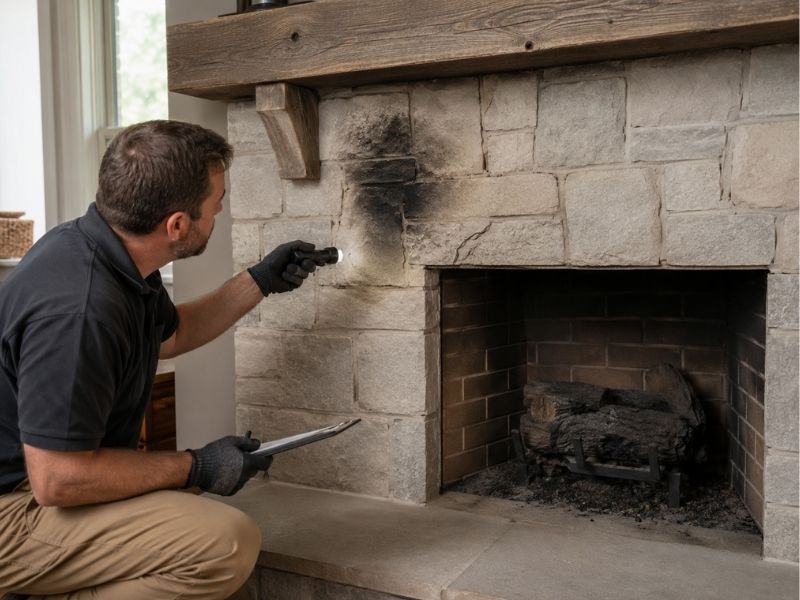
Fireplace repair is often needed when smoke stains keep returning to the same area after cleaning. Recurring stains may indicate that smoke, heat, moisture, or another underlying issue is affecting the fireplace or chimney system. Cleaning the surface alone addresses the visible marks but not the condition causing them to reappear. Fireplace repairs should address the underlying issue before cosmetic work begins.
Reading a Stain Instead of Just Cleaning It
A stain has a shape, a location and a color, and each of those carries information for someone who knows what to look for. Dark sooty marks above a firebox opening suggest smoke rolling out into the room rather than up the flue. Rust colored or chalky white staining more often points to water rather than combustion, since moisture carries minerals and metal oxides through masonry as it dries.
Location narrows it further. Stains along one side of a chimney breast can indicate a crack or open joint on that face, while marks that appear on a ceiling or a wall next to the chimney suggest something moving inside the chase. Stains that show up on an exterior chimney after rain point toward the top of the system rather than the firebox. None of this replaces a proper inspection, and appearance alone can’t confirm a cause. It does tell an inspector where to look hard, which shortens the search and keeps the repair focused.
Mortar Joints That Have Opened Up
Mortar is usually the first part of a masonry system to give out, and its failure creates exactly the kind of small continuous path that produces recurring stains. Joints inside the firebox take direct heat and cool again with every fire, and that cycling breaks down ordinary mortar over the years. Once a joint opens, smoke and combustion gases have somewhere to go besides the flue.
The smoke chamber above the firebox deserves the same attention, since gaps there let smoke into wall cavities where it stains from behind. Deteriorated joints on the exterior chimney allow rain into the masonry, and that water carries salts to the surface as it evaporates. Repointing addresses these openings, though the mortar has to suit the location, because a firebox needs refractory mortar rather than the mix used on an outside wall. Painting or sealing over open joints traps the problem instead of solving it, and the stain simply works its way back through.
Water Getting In From the Top
Plenty of recurring stains have nothing to do with fire at all. Chimney flashing is the metal that seals the joint between the chimney and the roof, and when it lifts, corrodes or was installed poorly, water runs straight into the structure. That water travels down through the masonry and shows itself as a stain on a wall or ceiling well below the entry point.
A missing or damaged chimney cap causes similar trouble by leaving the flue open to rain and snow. Water sitting inside a flue mixes with soot and creosote, producing an acidic residue that attacks mortar and liner alike, and it often leaves dark streaking near the firebox. Cracked crowns at the top of the chimney let water into the masonry from above as well. All of these get worse quietly, since the damage happens in places nobody inspects between fires, and the visible stain is usually the last stage rather than the first.
Damage Hiding Behind the Marks
The firebox itself may be in worse condition than the stain suggests. Firebrick cracks under repeated heating, and the refractory mortar between those bricks erodes until gaps appear. Behind a firebox with failing brick sits the structural masonry of the chimney, which was never meant to take direct flame contact.
Damage in this area affects performance in ways owners notice before they understand. Fires that seem harder to start, smoke that lingers in the room, or heat felt on a wall next to the fireplace can all trace back to firebox deterioration. A stain on the face may represent a small visible edge of something considerably larger inside. This is why inspection matters more than appearance, and why a chimney professional will look at the firebox, the smoke chamber, the flue liner and the crown rather than only the surface that shows the mark. Repairs planned from a full picture cost less than repairs planned from a guess.
Fixing the Cause Before Touching the Finish
Order matters in this kind of work. Water entry gets sealed first, then damaged mortar and firebrick get replaced, then the flue and cap get addressed, and only after all of that does anyone clean or refinish the visible surface. Reversing that sequence wastes the cost of the finish work, because a fresh coat over an active leak will stain again within a season or two.
Masonry also needs time to dry before it takes any coating. A wall that absorbed water for years holds moisture well after the leak stops, and paint applied too soon peels or blisters. Owners who wait for the masonry to dry and then use breathable products get a finish that lasts. Documenting what was found and what was repaired also helps later, since the next stain, if one appears, can be compared against a known baseline instead of starting the investigation over.
