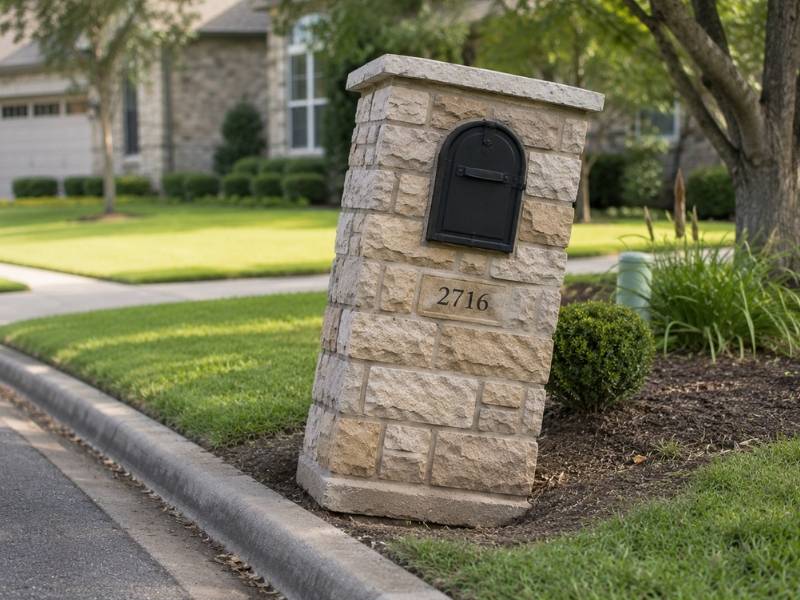
A stone mailbox can begin showing signs of movement before cracks appear in the mortar or masonry. Changes in the foundation, soil conditions, drainage, or normal settlement may cause the structure to lean gradually over time. Because these early signs can be easy to overlook, identifying the cause of the movement before visible damage develops allows property owners to evaluate the condition of the mailbox and determine whether repairs or foundation improvements are needed.
Small Changes in Alignment Come First
A mailbox that leans slowly rarely looks wrong from any single angle. Standing directly in front of it, a two degree tilt disappears, and the eye adjusts to what it sees every day. The lean shows itself against a straight reference instead, so comparing the mailbox to a fence line, a driveway edge, a light post or a neighbor’s mailbox works far better than a casual glance.
A few simple checks catch movement early. Sighting along the front face from a few feet to the side reveals tilt the front view hides, and holding a level against a vertical edge takes about ten seconds. Gaps opening between the mailbox base and the surrounding soil, mulch pulling away from one side, or a door that suddenly binds all point to the same thing. Homeowners who check once or twice a year usually find movement while stone mailbox repair may still involve resetting the footing rather than rebuilding the entire structure.
The Footing Moves Before the Masonry Does
The stonework you see sits on a footing you don’t, and that footing depends entirely on the soil around it. Soil that swells when wet and shrinks when dry moves the footing with it, and the mailbox rides along. Ground that wasn’t compacted during the original build settles under the weight of the masonry over the first few years, which produces the classic slow lean toward whichever side gave way first.
Depth is the other common failure. A footing poured too shallow sits within the zone where frost and moisture changes have the strongest effect, so it lifts and settles seasonally until the structure loses plumb. Erosion works the same way from a different direction, washing soil out from one side of the footing until support becomes uneven. Rebuilding the stonework on a footing that still moves simply resets the clock, and the same lean returns. Any real repair has to start below the masonry.
What’s Happening Around the Mailbox
The conditions near a mailbox often explain what the footing is doing. Driveway runoff, roof downspouts and street drainage all send concentrated water toward the curb, and mailboxes sit right in that path. Water moving repeatedly past one side of a footing carries soil with it, and the structure follows the loss.
Irrigation is a frequent and overlooked culprit. A sprinkler head that soaks the same patch of ground several times a week keeps the soil beneath the footing saturated, which softens support and encourages swelling in clay soils. Tree roots create a different problem by growing beneath and beside the footing, lifting it gradually and drying the soil as they draw moisture. Landscape changes matter too, since adding a bed, regrading a lawn or installing edging alters where water goes. Anyone planning a repair should look at these conditions first, because fixing the mailbox without addressing the water simply schedules the next repair.
Repairs That Address the Base and the Structure
An effective repair works from the ground up. That usually means excavating around the existing footing, evaluating whether it can be stabilized or needs replacement, and correcting the soil conditions before rebuilding anything above. Compacting properly, adding a gravel base for drainage, and pouring a footing sized for the mailbox mass and set below the local frost depth give the structure something reliable to sit on.
Once the base is sound, the masonry work becomes straightforward. Sometimes the stone can be reset with new mortar, and sometimes the upper courses need to be taken down and relaid, particularly where the lean has stressed joints. Owners occasionally ask whether the structure can simply be pushed back and braced, and that approach almost never lasts, because the underlying support hasn’t changed. Redirecting water away from the base with grading or a small drain during the same work keeps the repair from becoming a recurring expense.
Neighborhood Rules Can Shape the Repair
Many neighborhoods with stone or brick mailboxes established those standards on purpose, and the rules often survive in the association documents long after the original builder left. Requirements can cover stone type, mortar color, height, address numbering, overall dimensions and even whether replacement is allowed at all.
Checking those documents before ordering material avoids an unpleasant conversation later. Some associations require written approval before work begins and ask for a description of the materials, and a repair completed without it can be ordered redone at the owner’s expense. Postal placement standards apply as well, since the box height and setback from the curb face need to stay within the accepted range after the repair. Owners who confirm both sets of requirements early can hand a clear scope to a mason and get one repair rather than two.
