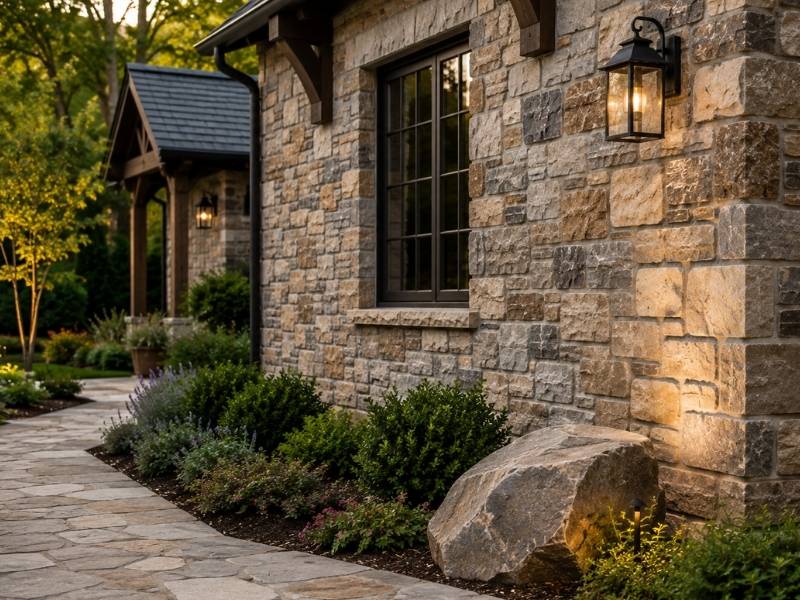
Look at a bad stone wall and you’ll spot the problem in two seconds without knowing why. Something repeats. A stone mason spends most of a job fighting that, because the human eye catches pattern faster than it catches anything else. The work that makes stone look like it grew there happens before the mortar comes out, and most of it happens on the ground.
Breaking Up Repetition Across the Stone Surface
Real stone comes in whatever sizes and shades the quarry hands over. That variation is the point, and it’s also the trap. Set two similar stones near each other and the eye locks onto the pair, then follows the rhythm across the whole wall.
The goal is a surface where nothing draws attention to itself. No stripe of light stones. No column of same-size blocks marching up one side, and nothing that says a person placed these in a hurry. That’s an eye job rather than a math job, and it’s the difference between a mason with fifteen years in and a guy with a wet saw.
Blending Stone From Several Pallets
Stone arrives on pallets, and each one gets loaded from a different part of the quarry face. Color and thickness shift between them, sometimes a lot. This natural variation is one of the reasons well-built natural stone walls look balanced instead of repetitive. Working straight off one pallet at a time builds a wall with visible bands in it.
Good masons open several pallets at once and pull from all of them. It’s called blending, and it costs time and space on a job site. A crew with one pallet cracked open and a wall going up fast is the thing to worry about.
Order enough stone up front too. A second delivery weeks later comes from a different part of the quarry, and that late material rarely blends with the first batch. Ten to fifteen percent extra is normal, and the leftovers cover future repairs.
Dry-Laying the Stone Before Installation
Before anything gets set, a good mason lays the stone out on the ground in front of the wall. Same shape, same size as the finished area, just flat. Stones get moved, swapped and turned until the layout stops repeating.
Sitting there on the dirt, a bad rhythm is obvious and free to fix. Once it’s mortared up, that same problem costs a chisel and a bad afternoon. Dry-laying looks like the crew is standing around doing nothing, and it’s the most productive hour of the job.
Checking the Layout From a Distance
Stand back fifteen feet and squint at the layout. Squinting drops the detail and leaves the pattern of light and dark. Anything your eye jumps to at that distance is a problem, and it’ll be worse on the finished wall.
Do the same with a phone photo in black and white. Color hides value problems, and stripping it out reveals them. It takes two seconds and almost nobody does it.
Hiding Saw Cuts and Preserving Natural Edges
Every stone has a face, which is the weathered or split surface meant to be seen. Cut through it with a saw and you expose fresh interior, which is a different color and dead flat. That saw cut screams from across the yard.
Skilled masons cut from the back and break to the front, so the visible edge is a natural fracture. Where a saw cut can’t be avoided, it goes at the bottom, at the top or against a corner where nothing sees it. Cut edges facing out at eye level are the mark of a crew in a hurry.
Chisel work matters here too. A hammer and chisel leaves an edge that reads like the rest of the stone, and it takes far longer than a saw. That labor is what you’re paying for on a good job.
Keeping Stone Joints Consistent
Joint width is a design decision and it gets made once. Tight joints mean more shaping and more time, and they make the stone the star. Wide joints go faster and put mortar in the picture.
Either choice works. What kills a wall is inconsistency, where joints run half an inch in one spot and two inches in another because the stones didn’t fit. That’s a fitting failure showing up as a mortar problem.
Watch for stacked joints too. When the gaps line up vertically across two or three courses, you get a running joint, and the eye follows it straight up. Masons break those on purpose by shifting the stone above, and pointing style then decides the finish. Mortar raked back into shadow makes stones look thicker and more separate, while mortar brought flush makes the wall read as one mass.
Finishing Corners and Exposed Edges Properly
A corner is where two faces meet and the fiction has to hold on both sides. Real stone corners need units with two finished faces, and those cost more and come in limited quantity. Skimping here produces a visible seam, and that seam undoes the entire wall.
Terminations matter as much. Where the stone stops at a window, a door or an open edge, something has to close it out honestly. A wall that just quits, showing its thin cut edge, tells the viewer it’s a skin instead of a structure. Wrapping the corner and returning the stone past the sight line fixes most of it, and so does a proper sill or cap.
Questions to Ask Before Hiring a Stone Mason
- How many pallets will be open at once during setting?
- Will the stone be dry-laid before it’s set, and where?
- How are saw cuts hidden, and what happens at exposed edges?
- What joint width and pointing style are you quoting?
- Do the corners use two-faced units, and are they in the price?
- Can I see a wall you built three years ago, not last month?
That last one is the whole interview. New work always looks fine. A three-year-old wall shows whether the joints held, the corners stayed shut and the blend still reads as natural.
Frequently Asked Questions
What Makes a Natural Stone Installation Look Seamless?
Blending stone from several pallets at once, dry-laying the pattern before setting, hiding saw cuts and keeping joint width consistent. The eye catches repetition faster than anything else, so the work is about breaking up rhythm. Most of it happens on the ground before mortar goes near the wall.
Why Does My Stone Wall Look Patchy or Striped?
Stone was likely set straight off one pallet at a time. Color and thickness shift between pallets because they come from different parts of the quarry face, and working through them in order builds visible bands. Opening several pallets and pulling from all of them prevents it.
Should Stone Be Dry-Laid Before Installation?
Yes, on any visible wall. The mason lays the stones flat on the ground in the finished shape, then moves and swaps them until no pattern repeats. Fixing a bad layout on the dirt is free, and fixing it after the mortar sets means a chisel and a lost day.
How Can You Tell Good Stonework From Bad?
Look for saw-cut edges facing out at eye level, joints that jump from narrow to wide, gaps that line up vertically across courses, and corners with a visible seam. Then step back fifteen feet and squint. Anything your eye jumps to at that distance is a flaw.
Do I Need Extra Stone for a Natural Stone Project?
Order ten to fifteen percent over. Stone from a later delivery comes from a different part of the quarry and rarely blends with the first batch, so a shortage mid-job shows up permanently in the wall. Keep the leftovers on site for future repairs.
