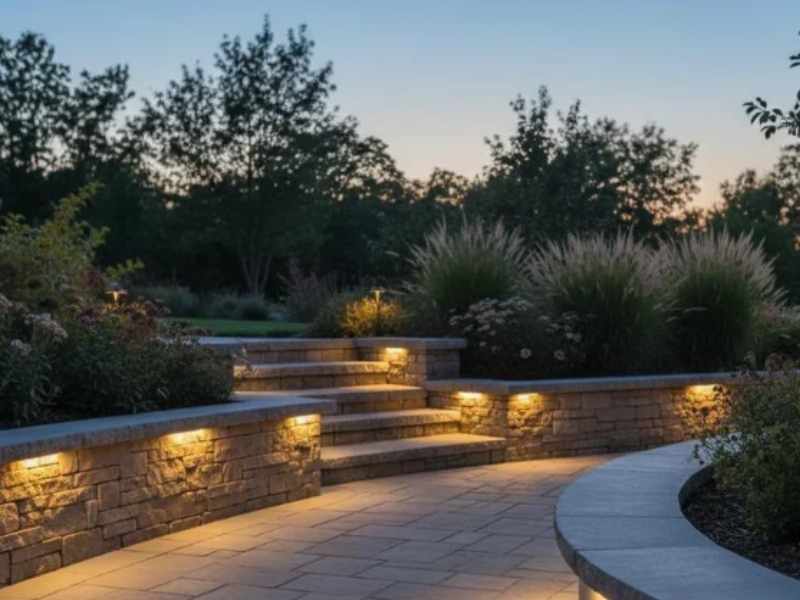
Retaining wall lighting can make a yard feel finished after dark. Steps glow, paths are easy to follow, and the masonry looks just as good at night as it does in daylight. Getting there means cutting openings into a structure whose whole job is holding back soil and water. Planning lighting niches while the retaining wall is still on paper keeps the lights working and the wall strong.
Planning Lighting Niches Within a Retaining Wall
Start with what the light needs to do. Step lights, path lights, and accent lights each work best at different heights and spacing. Mark where people walk, sit, and need to see before choosing locations.
Structure comes next. Walls that hold back significant soil may be engineered, with reinforcement or soil grid behind the face. Niches shouldn’t cut through those elements or weaken key sections. Ask your mason which parts of the wall can safely hold an opening.
Upper courses near the cap often carry less load than lower ones. Stair walls and short seat-height walls are common spots for lights. Some segmental wall systems include units designed for recessed fixtures, which avoids cutting into regular block.
Choosing Niche Dimensions for Recessed Landscape Light Fixtures
Pick the fixtures before construction. Each light comes with specific dimensions for its housing, trim, and mounting depth. The mason sizes each niche to match.
A niche that’s too large leaves gaps that collect water and debris. One that’s too small forces cutting on site, which can crack nearby brick or stone. Exact sizing keeps the finish clean and the fixture secure.
Think about light direction too. Fixtures mounted low and angled down light paths and steps without glaring into eyes. Spacing should create even light without dark gaps or hot spots.
Niches look best when they line up with masonry joints. In brick masonry, that often means sizing niches to fit a full brick or course. With stone masonry, the mason can shape the surrounding pieces so the fixture looks intentional.
Integrating Electrical Conduits Into Retaining Wall Construction
Wiring is much easier to plan than to retrofit. Conduit runs can be set as the wall goes up, so each niche has a protected path for wires. Running wire after the wall is finished often means drilling through masonry or digging behind it.
Coordinate with your electrician early. Low-voltage lighting is common for landscape use, but the transformer, connections, and any line-voltage work must follow electrical code. Local rules vary, so let a qualified electrician guide the design.
Keep conduit clear of structural parts. Reinforcement, soil grid, and the drainage zone behind the wall all need to stay intact. Routing conduit along the top of the wall or through planned openings can avoid conflicts.
Add a pull string in each conduit run. It makes replacing wires or adding fixtures later much easier. Mark where conduits enter and exit so future crews can find them.
Protecting Lighting Niches From Moisture and Drainage Exposure
Retaining walls handle a lot of water. Soil behind the wall stays damp, rain washes down the face, and irrigation adds more. Every niche is a possible entry point.
Shape the niche so water drains out. A slight slope toward the face keeps it from pooling around the fixture. Sealing gaps around the housing with appropriate materials helps keep water out of the masonry.
Drainage behind the wall still matters most. Gravel backfill, drain pipes, and weep openings carry water away from the soil side. Lights installed in a wall with poor drainage often fail early or stain the face.
Wire splices and connectors should sit where water can’t reach them easily. Use fittings rated for wet locations. Water at the connection point is a common reason outdoor lights flicker or fail.
Maintaining Built-In Lighting Without Disturbing the Retaining Wall
Good lighting design plans for maintenance. Choose fixtures that can be serviced from the front without removing surrounding masonry. Bulb or module changes should take minutes, not a call to the mason.
Inspect lights each season. Look for cracked lenses, loose trim, or water inside housings. Clear debris from niche openings so water drains freely.
If a fixture fails completely, replacing the housing should not require breaking into the retaining wall. That’s why fixture choice and conduit planning matter up front. Fixing a poorly planned niche can mean rebuilding part of the wall.
Frequently Asked Questions
Can lights be added to an existing retaining wall?
Sometimes, but it’s harder than planning them during construction. Cutting niches into a finished wall can weaken it, especially in lower courses. Running wire may require drilling or digging. A mason can tell you whether your wall can handle retrofit lighting.
Do lighting niches weaken a retaining wall?
Poorly placed or oversized niches can. Well-planned niches in suitable locations usually don’t affect performance. Engineered walls need extra care so reinforcement isn’t disturbed. Ask your mason or the wall’s engineer before cutting any openings.
What type of lights work best in masonry walls?
Low-voltage recessed fixtures rated for wet locations are common choices. Step lights, louvered fixtures, and small accent lights fit many designs. LEDs last a long time and run cool. Choose fixtures before construction so niches match exactly.
