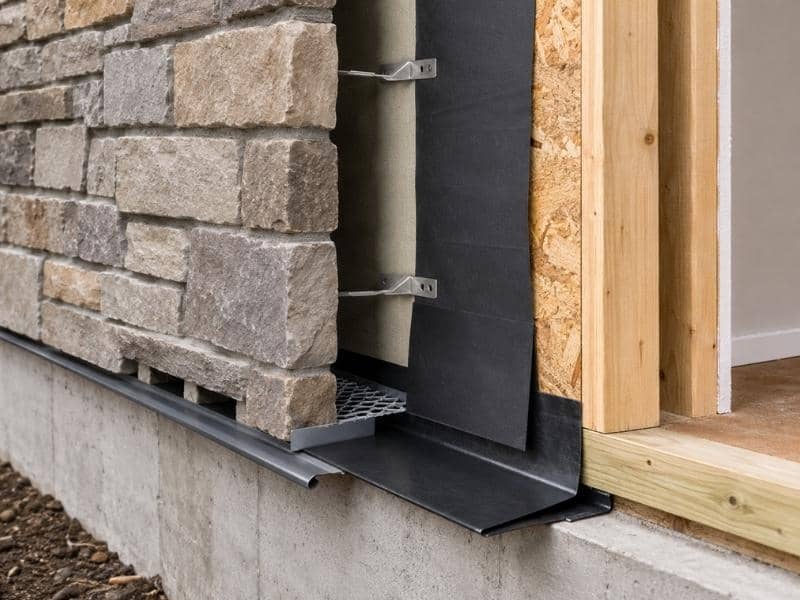
A white crust keeps returning on a stone wall, or a damp patch shows up inside where it shouldn’t. Both point to water that got behind the stone and couldn’t get back out. Stone masonry isn’t a waterproof shell, so a well-built wall gives that hidden water a way to drain instead of trapping it against the structure. The weep paths, the cavity and the flashing behind the stone do that quiet work. This article explains how water gets in, how the drainage cavity and flashing move it toward an exit, why weep openings stop working and what repeat efflorescence is really telling you. For anyone building or maintaining stone walls, these details decide whether moisture drains away or slowly does damage.
How Water Enters Behind Stone Masonry
Stone masonry looks solid, but a stone wall isn’t a waterproof shell. Wind-driven rain pushes moisture through joints, hairline cracks and the small gaps around windows and doors. Water works its way through mortar over the years too. Given enough weather, some moisture will always reach the space behind the stone.
That’s why good wall design plans for the water that gets in. The stone face is the first line of defense, and it sheds most of the rain that hits it. The rest of the assembly handles what slips past. A wall built this way moves hidden moisture back out before it can sit against the structure and cause damage.
Understanding this changes how you read a wet wall. A little water behind the stone isn’t a defect on its own. The real question is whether the wall can move that water back out, and every part below depends on the answer.
The Drainage Cavity Behind the Visible Stone Surface
Behind the visible stone sits a gap that does quiet, important work. This drainage cavity gives water a clear path to travel down and out, instead of soaking into the wall backing. When the space stays open, moisture that gets past the stone runs down the back of the veneer and drains away at the bottom.
That only works if the cavity stays clear. During construction, mortar can squeeze out the back of the joints and pile up in the gap. Dropped debris, misplaced insulation and sloppy installation can block it just as easily. Any of these can dam the cavity and trap water exactly where it’s supposed to flow through.
A blocked cavity turns a drainage path into a holding tank. Water backs up against the wall backing, keeps the area damp and works into whatever material sits behind the stone. Over time that trapped moisture rots framing, corrodes metal and feeds mold. Keeping the cavity open is one of the plainest ways to keep a stone wall dry inside.
How Flashing Directs Hidden Moisture Toward an Exit
Flashing is the part that catches hidden water and sends it back outside. It’s a water-resistant layer built into the wall at spots where moisture tends to collect. You’ll find it at the base of walls, above windows and doors, where roofs meet walls and at other transitions where water could sneak deeper into the structure.
The job of flashing is to gather water inside the assembly and aim it toward the weep openings that let it escape. For that to happen, the flashing has to sit in the right place and lap the right way, with each piece overlapping the one below so water runs across the top and off the edge. Set it backward or leave a lap open, and the flashing funnels water into the wall instead of out of it.
Flashing and weeps work as a team. The flashing collects the water and carries it to the base, and the weeps give it a door to the outside. Miss either one, and moisture that made it into the cavity has nowhere to go. Correct flashing turns a wet cavity into a wall that drains itself.
Why Stone Masonry Weep Openings Become Blocked or Ineffective
Weep openings are small gaps left near the bottom of a stone wall to let trapped water out. They only help when water has a clear, continuous path leading to them. Plenty of walls have weeps that do nothing, because something upstream cut off the route or the opening itself got plugged.
The common failures are easy to picture. Mortar bridges across the cavity and blocks the flow before it reaches the weep. Debris clogs the opening from inside. Sealant gets smeared over the weeps during a later repair. Sometimes the weeps sit above the flashing instead of right at it, so water collects below the opening and never rises to reach it.
A weep can’t drain a wall it isn’t connected to. If the cavity is dammed, the flashing is misplaced or the opening is buried, the water just pools somewhere inside and waits. That’s why a mason checks the whole path, not only the visible hole. An open weep at the surface means little if the water can’t get to it.
Connecting Recurring Efflorescence to Hidden Drainage Problems
That white, powdery film that shows up on stone and mortar has a name. It’s called efflorescence, and it works like a moisture message. Water moving through the masonry dissolves salts inside the stone and mortar, carries them to the surface and leaves them behind as a white crust when it evaporates. The stain is the salt the water left on its way out.
A little efflorescence after construction is common and usually fades. Efflorescence that keeps coming back is a different story. Repeated deposits mean water keeps moving through the wall in volume, over and over, in the same place. Scrubbing off the white residue cleans the symptom and ignores the cause. Days or weeks later, it returns.
When efflorescence keeps returning, the smart move is to look at the drainage system behind the stone. Check the flashing, the cavity, the coping on top of the wall, the joints and the weep paths for the leak that’s feeding it. Fixing where the water gets in and how it gets out stops the salts at the source. Clean the surface all you want, but the stain won’t quit until the moisture path does.
