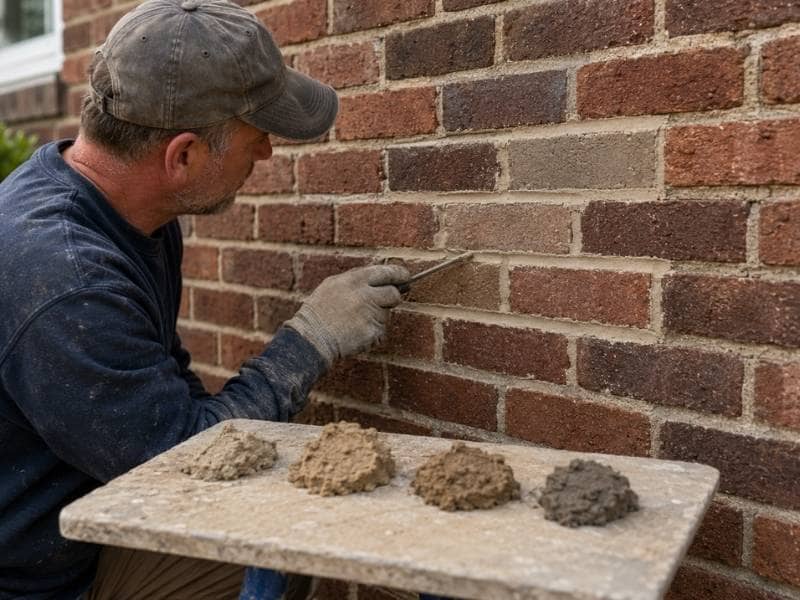
A repair can hold up perfectly and still look wrong. When a new mortar sits next to old and the color or shape is off, the eye goes straight to the patch. A skilled brick mason treats mortar matching as an essential part of brick masonry, not an afterthought. The goal is a repair that blends in so well most people never spot it. Getting there takes the right reference, some patient testing, and real attention to how the joint gets finished.
Pull Your Reference From Inside the Joint
The mortar you see on the wall surface has been through a lot. Sun, rain, dirt, and biological growth all change how it looks over the years. Cleaning products and simple age shift the color further. Matching to that weathered face means matching to a color the original mortar never actually was.
A better reference comes from mortar taken from inside the joint, where the weather never reached. That protected material sits closer to the original mix and gives a truer starting color. A mason who chips out a small hidden sample has something honest to match against.
Working from the faded surface almost guarantees a mismatch once the new mortar cures and shows its real tone. The inside of the joint is the closest thing to a time capsule the wall has. Starting there points the whole match in the right direction from the first batch.
Separate the Mortar Color From the Sand
Mortar color isn’t one simple thing. Cement, lime, and any added pigment all feed into it, but the sand does heavy lifting too. Sand color, particle size, and how the grains spread through the mix all shape the finished look. Two mortars can share a recipe and still land in different places because their sand differs.
This is why matching by color alone falls short. A mason who picks a mix that looks close in a bucket can still end up with joints that read as off once they dry. Studying the sand in the original mortar, its shade and its grain, points toward the right blend.
The sand often decides the match more than the cement ever does. A coarse, warm sand and a fine, gray one will finish as different joints even with the same cement and lime. Getting the sand right is half the battle, and it’s the half people skip most.
Test Small Batches and Let Them Cure
Wet mortar and cured mortar are two different colors. Fresh mix looks darker and richer than it will once it dries out and sets. Judging a match while the mortar is still wet leads to joints that turn too light or too gray days later. The cured color is the only one that counts.
The fix is to mix a few trial batches and let each one dry fully before choosing. A mason then holds the cured samples right against the existing wall and compares them in daylight. The closest cured match wins, not the one that looked best wet.
That patience up front prevents a repair that only reveals its mismatch after everything is set and hard to undo. A few test batches cost a little time and almost nothing in material. That small effort saves a joint that would otherwise stand out on the wall for good.
Copy the Shape and Finish of the Old Joints
Color is only half the match. The original joints have a certain depth, width, profile, and surface texture, and all of that reads as strongly as the tone does. A joint tooled to a different shape stands out even when the color is dead on. The light hits it differently, and the eye catches the change.
Reproducing the old joint means matching how it was struck and finished. A joint that sits too smooth, too deep, or shaped with the wrong tool breaks the pattern of the wall. A mason studies the existing profile and works the new joints to the same depth and finish.
Matching the tooling method ties the repair into the surrounding brickwork instead of framing it. The way a joint catches shadow depends on its shape, so a matched profile blends where a mismatched one glares. Small details in the tooling carry more weight than most people expect.
Blend the Edges of the Repair
The last thing you want is a neat rectangle of new mortar announcing itself on the wall. A repair that stops in a clean box draws the eye no matter how good the color is. A brick mason instead picks logical stopping points that follow the natural lines of the brickwork. Feathering the boundary into the surrounding joints softens where old meets new.
Careful work at the edges holds the entire mortar repair together. That means removing the old mortar cleanly, protecting the brick faces during the work, and cleaning the area without harsh scrubbing. Curing the new joints at an even pace helps them settle to a consistent color across the whole repair.
When the boundary disappears into the wall, the patch stops looking like a patch and starts looking like the wall always did. A repair done this way rewards the extra care with something you have to search for to find. That’s the mark of a match done right.
