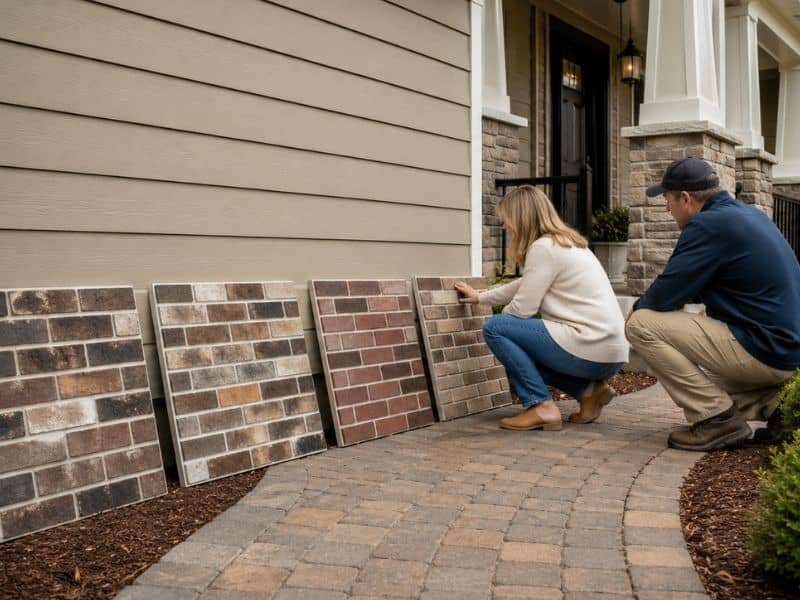
For exterior remodeling projects, brick is often the material that ties an updated entry, façade accent, porch, or outdoor feature back to the home. Choosing it early makes the rest of the design easier to plan and coordinate.
Most homeowners work backward. They pick a paint color, a trim style, or a roofing accent first, then go looking for brick that matches. This usually causes problems. Paint and trim colors can be mixed to order. Brick can’t. Once a batch is made and fired, that color and texture are set. It makes more sense to lock in the brick first and build the rest of the exterior around it.
This matters just as much for property owners planning a resale as it does for a family staying put for twenty years. A mismatched exterior can sit on the market longer. A well-coordinated one photographs better and reads as finished, not patched together.
Brick Sets the Visual Direction Before Other Exterior Choices Multiply
Brick color, texture, size, and joint style set the tone for the whole exterior. A warm red brick with a rough, tumbled texture reads completely differently than a smooth gray brick with tight, dark joints. Once that choice is made, everything else has a starting point.
Here’s how it plays out in practice:
- Siding color needs to sit next to the brick’s undertone, not fight it. A brick with warm orange tones will clash with a cool blue-gray siding.
- Trim color should either pick up the mortar shade or contrast against it on purpose. Guessing at this before the brick is chosen almost always ends in a repaint.
- Roofing accents, like dark shingles or metal flashing, look intentional when they pull a color that already exists in the brick.
- Metal finishes on doors, railings, and light fixtures should lean warm or cool depending on the brick tone next to them.
Pick brick first, and these decisions come together on their own. Pick brick last, and you end up trying to match five separate materials to a wall you haven’t chosen yet.
A Sample Panel Can Answer Questions a Screen Image Cannot
A photo on a website, or a small chip handed over at a supply yard, does not tell the full story. Brick looks different indoors under store lighting than it does outdoors on a wall.
Ask for a full sample panel, not a single brick. Set it against the actual house, not on its own against a fence or a table. Look at it in the morning, again at midday, and once more near sunset. Shade from a tree, a neighboring roofline, or the direction your house faces can shift how a brick reads by several shades over the course of one day.
Pay attention to what sits next to the sample, too. Existing stone, siding, or a driveway color can pull a brick warmer or cooler than it looks on its own. A brick that seems perfect in a showroom can look off once it’s next to the rest of the property.
This one step, standing outside with a real panel, prevents most of the regret homeowners feel after a brick order arrives.
Brick Dimensions Shape Corners, Openings, and Remodel Transitions
Size matters as much as color. Brick dimensions affect how courses line up around windows, doors, columns, additions, and new accent walls.
If a new brick is even slightly taller or shorter than the existing brick, every course line where new work meets old work gets thrown off. That shows up as visible seams, awkward cuts near corners, and mortar joints that don’t line up from one section to the next.
Before adding a porch, an entry feature, or a small addition, check that the brick size and course height match the existing brick, or plan an intentional contrast instead of an accidental one. A mason can walk the project early and point out any spot where an odd cut or an uneven line is likely to show up later.
Skipping this step is one of the most common reasons a remodel ends up looking stitched together instead of built as one piece.
Selecting Brick Early Helps Coordinate the Materials That Meet It
Brick rarely stands alone on a wall. It meets flashing, trim boards, ledgestone, cladding, pavers, and light fixtures at dozens of points around a home.
Each of those meeting points needs a plan:
- Flashing has to match the brick’s reveal and keep water moving away from the wall, not behind it.
- Trim boards need a reveal depth that looks planned next to the brick, not squeezed in as an afterthought.
- Ledgestone or stone accents should sit at a height and tone that pairs with the brick instead of competing with it.
- Pavers and walkways near an entry look better when they pick up a tone already present in the brick.
Choosing brick before ordering these other materials means each one gets picked to work with it. Choosing brick last means reworking, or living with, pieces that were already ordered and don’t quite fit.
Early Brick Decisions Keep a Remodel From Looking Like Several Separate Projects
Remodels often happen in stages. A porch this year, a façade refresh next year, an addition after that. Without a shared brick decision made up front, each phase can end up looking like its own separate project instead of one home.
Pick the brick early, and it becomes the thread that ties every phase together. An entry update, a new porch, a façade refresh, and a small room addition all read as one plan carried out over time, not a string of unrelated projects stapled onto the same house.
For land developers and builders working on multiple properties, this same logic scales up. Setting a brick standard early, before trim, stone, and paving get ordered project by project, keeps a whole street or subdivision looking cohesive instead of mismatched lot to lot.
That’s the real value of choosing brick first. Not just a wall that looks good on its own, but a property that reads as one finished place, built with a plan, rather than a set of separate decisions made months or years apart.
