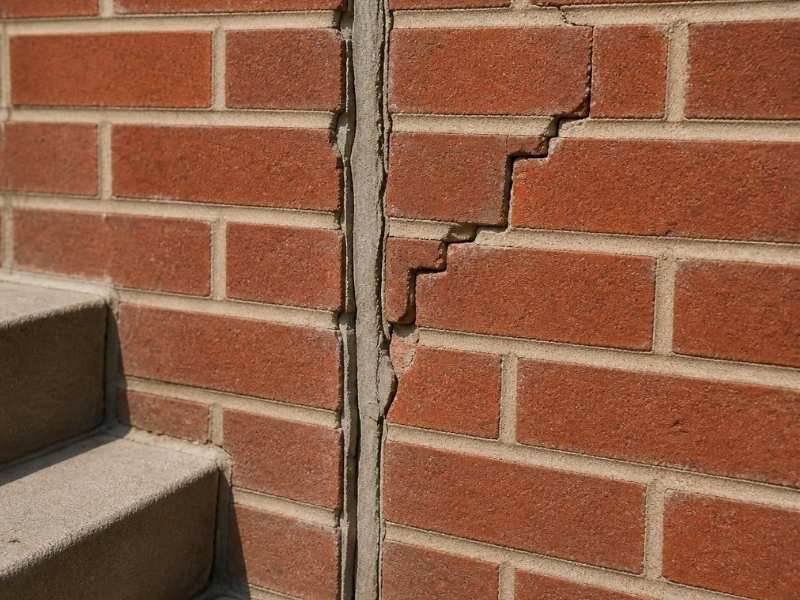
Run your eye down a long brick wall and you will find a thin vertical line filled with soft sealant. That line is one of the brick masonry expansion joints, and it does a quiet but big job. It gives the wall room to grow and shrink as the weather changes. When the seal in that joint hardens, cracks or gets filled with mortar, the wall loses that room and starts to crack on its own. For developers building long walls around Frisco, where summers bake the brick and winter nights drop below freezing, that back-and-forth movement never stops. A joint that cannot move is a wall that will crack.
What an Expansion Joint Is Doing
A brick wall does not sit still. It takes in moisture, warms in the sun and cools at night. Each change makes it swell or shrink a hair, and those small moves add up over a long run. An expansion joint is a planned soft gap that swallows that movement, so the growth lands in the gap instead of the brick.
An expansion joint is different from a mortar joint. A mortar joint is hard and holds brick together. An expansion joint stays open and flexible, filled with backer rod and sealant, so the two sides can move without pushing on each other. Mix those two up and you get the most common mistake on this whole topic.
How to Spot a Joint That Has Failed
The best time to check is twice a year, once in the heat and once in the cold, since a stressed joint shows it most in the extremes. Walk the wall slow and look at each vertical line up close.
- Sealant that has gone hard, brittle or chalky instead of soft and springy
- Sealant cracked down the middle or pulled away from the brick on one side
- A joint packed with mortar or painted over, so it can no longer move
- A lumpy, wrong-color caulk line where someone patched it fast
- A long straight wall with no soft joint at all
Press the sealant with a key or screwdriver. Good sealant gives a little. Bad sealant feels like rock or crumbles. A gap that looks dry, split or stuffed with something hard has failed.
What a Bad Joint Does to the Wall
A joint that cannot move pushes the problem into the brick. The wall still wants to grow, but now it has nowhere to go. So it cracks, often near corners, windows or where the wall changes height. Brick edges along the stuck joint can chip and flake off as they grind together. A long run with no joint can even bow out.
Water is the part that turns a small problem into a big one. A split seal lets rain sit in the open joint. On a cold night that water freezes, swells and pries at the brick and mortar around it. Do that a few dozen times over a winter and the edges start to crumble. Caught early, this is a reseal. Left alone, it can turn into brick replacement or a wall that needs rebuilding at one end.
How to Reseal an Expansion Joint the Right Way
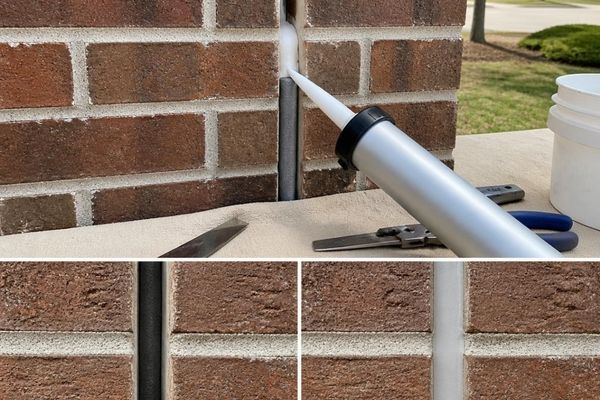
Start by clearing the joint, not covering it. Rake out the old, dead sealant all the way down with a hand tool or an oscillating tool. Brush the joint faces clean so the new sealant can grab bare, dry brick. Do not smear fresh caulk over a cracked line, since it will fail again in a season.
Push in the backer rod to set the right depth. The rod also keeps the sealant from sticking to the back of the joint, which is what lets it stretch. Then fill the joint with a flexible sealant made for masonry. Tool the bead smooth so it presses into both faces and sheds water. Match the joint width the wall was built for, and keep the sealant soft and slightly recessed so it can move. Give it time to cure before rain hits it, which the product label will spell out. Plan the work for a dry day at mild temperature, since wet or freezing brick will not let the sealant grip.
What Never to Do
Never fill an expansion joint with mortar. Hard mortar locks the wall and starts the cracking all over again. Never paint the joint shut, since a coated joint cannot move and the paint hides it from the next person. And never caulk over old dead sealant, because the fresh bead only grips the failure underneath.
When to Bring in a Pro
One clean joint is a steady weekend job. A long wall with many failed joints, a joint packed solid with mortar or a wall built with no joint at all is a different story. Those need a mason, and a missing joint on a tall or load-bearing wall needs an engineer to place it right. Call before the cracks spread, not after.
Frequently Asked Questions
What is the difference between an expansion joint and a mortar joint?
A mortar joint is the hard line that bonds brick to brick. An expansion joint is a soft, open gap built to move. One holds the wall together, the other lets it flex. Filling an expansion joint with hard mortar cancels the whole point of it.
Can I just caulk over a cracked expansion joint?
No. Caulk laid over dead sealant only sticks to the old failure, so it splits again fast. Rake the joint clean, set the backer rod for depth, then apply fresh masonry sealant. Doing it right once beats patching it every year.
How often do expansion joint seals need replacing?
Most joint sealant lasts several years before it hardens or pulls loose, often in the range of ten to twenty. Sun, heat and weather wear it faster. Check the joints once a year and reseal the ones that have gone stiff or cracked before water gets in.
What happens if a long brick wall has no expansion joint?
The wall has no room to grow, so it makes its own room by cracking. You will see cracks near corners and openings, chipped brick edges and sometimes a bow in the wall. Adding a proper joint later takes a mason or engineer, so it is best planned early.
Can a mortar-filled expansion joint be fixed?
Yes, but it takes real work. A mason cuts the mortar back out of the joint, cleans the edges and rebuilds it as a soft joint with backer rod and sealant. Once it can move again, the cracking around it usually stops.
